How to Store Summer Bedding So It Does Not Smell Musty Next June
Quick Answer: Musty stored bedding is almost always caused by residual body oils and moisture, not by dust. Wash everything on the warmest cycle the label allows, dry it completely - genuinely completely, not almost - skip fabric softener, and store it in a breathable cotton bag or pillowcase rather than a sealed plastic bin. Somewhere cool and dry, not the attic and not the basement. Ten minutes of preparation is what decides whether next June smells like fresh linen or a damp cupboard.
You pull the summer sheets out in June and there it is - that flat, closed-in smell that no amount of airing quite removes.
The box did not do that. The way the sheets went into the box did.

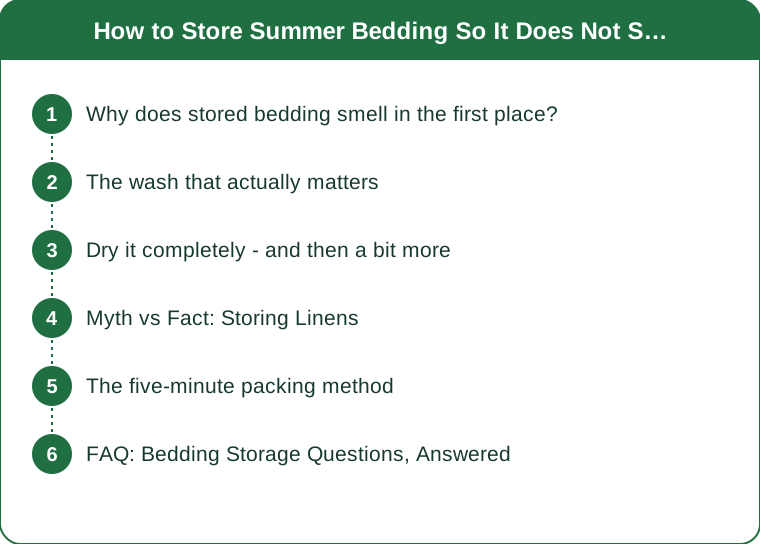
Why does stored bedding smell in the first place?
Two causes, and they compound.
The first is residual body oil. Sheets absorb skin oils and sweat, and a normal wash removes most but not all - particularly on a cool cycle with a heavy detergent load. Those oils oxidise slowly over months, which is what produces the stale, slightly rancid note under the mustiness.
The second is moisture. Fabric that goes into storage even slightly damp, or that sits in a humid space, supports mildew growth. That is the specifically musty smell, and it is much harder to remove once established because it means something has actually grown in the fibres.
Both causes point at the same conclusion: the problem is created at packing time. Storage does not generate smell, it preserves and concentrates whatever was already there.
Which is good news, because the fix is entirely front-loaded.
The wash that actually matters
The final wash before storage is different from a normal weekly wash, and it is worth treating that way.
Use the warmest water the care label permits. Cotton and linen generally tolerate a warm or hot wash, and heat is what removes oils that a cold cycle leaves behind. This is the single highest-value step.
Skip fabric softener entirely. Softener works by leaving a waxy coating on fibres. In storage that coating traps oils, holds odour, and reduces breathability - and on towels and technical bedding it also builds up over time. Half a cup of white vinegar in the rinse compartment softens without the residue.
Do not overload the machine. Bedding needs room to move for detergent to reach all of it. Two sets in one drum usually means neither gets properly clean.
Consider a second rinse. Detergent residue is itself a smell source over months, and bulky bedding holds more of it than a normal load.
Dry it completely - and then a bit more
This is where most storage failures actually happen. Bedding that feels dry to the hand can still hold enough moisture to support mildew over eight months in a closed box.
The safest approach is line drying in sun if you have it - sunlight is genuinely antimicrobial and it leaves that clean smell people try to buy in a bottle. Then finish in a dryer on low, or leave it draped somewhere airy for several more hours.
Pay particular attention to thick items: duvets, mattress protectors, and quilted anything. The outer layer dries long before the filling does, and a comforter that felt dry on the surface is the classic source of a musty smell in spring.
A practical test for bulky items: press the thickest part firmly against your cheek. Cool and slightly heavy means there is still moisture in there. Warm, light, and dry means it is ready.
If you have any doubt at all, wait another day. There is no rush, and this is not a step that can be corrected later.

Myth vs Fact: Storing Linens
Myth: Vacuum bags are the best way to store bedding. Fact: They are excellent for space and terrible for natural fibres over a season. Cotton and linen need some air exchange, and compressed fibres develop set creases that are difficult to remove. If space forces the issue, use them for synthetics and keep natural fibres breathable.
Myth: Plastic bins keep bedding cleaner. Fact: Sealed plastic traps whatever moisture went in with the fabric. If you use bins, leave the lid slightly ajar or drill a few holes, and put the bedding inside a cotton bag first.
Myth: Scented sachets prevent musty smells. Fact: They mask, they do not prevent. A cedar block or lavender sachet is pleasant and mildly deters moths, but it does nothing about moisture or residual oils. Do not let it substitute for the wash and the drying.
Myth: The attic or basement is the obvious storage spot. Fact: They are the two worst places in most homes. Attics swing through wide temperature and humidity ranges; basements are damp. Under a bed, on a high closet shelf, or in a spare wardrobe is far better.
Myth: Starching before storage keeps linens crisp. Fact: Starch is a food source for insects and it can yellow over time. Store clean and unstarched; starch when you are about to use the item.
The five-minute packing method
Once everything is washed and genuinely dry:
Fold rather than roll for cotton and linen, and refold along different lines than last time if you can - permanent creases form where the same fold sits for years.
Store sets together. The fitted sheet, flat sheet, and pillowcases of one set, folded and slipped inside one of that set’s own pillowcases. It takes seconds, keeps sets intact, and gives you a breathable cotton container for free.
Label by set, not by season. Next June you want to find the linen set, not open four bags.
Choose the location deliberately: cool, dry, dark, and stable. Under-bed boxes are ideal because bedrooms are climate-controlled and the space is otherwise wasted.
Leave a note in the box if anything needs attention - a fitted sheet with failing elastic, a duvet cover missing a button. Future you will not remember, and that is how items get put back into rotation and quietly annoy you all summer.
FAQ: Bedding Storage Questions, Answered
What if my bedding already smells musty?
Wash it with a cup of white vinegar in place of detergent on a warm cycle, then wash again normally, then dry fully in sunlight if possible. That clears most cases. Mildew that has visibly stained the fabric is often permanent, though the smell can usually still be removed.
Should I wash bedding again before using it next season?
A quick refresh wash is nice but not necessary if it was stored properly. If it has been in storage more than a year, wash it - dust finds its way into everything eventually.
Is it worth storing summer bedding at all in a mild climate?
If you genuinely use lightweight sheets year-round, no - rotation keeps everything fresher than storage does. Storage is for the items that will genuinely sit unused for months.
How do I store a summer duvet or coverlet?
Same rules, more drying time. Do not compress it, store it flat or loosely folded in a large cotton bag, and give it a day of airing before use rather than putting it straight on the bed.
TL;DR:
- Musty storage smell comes from residual body oils and moisture, both created before the box closes.
- Wash on the warmest cycle the label allows, skip fabric softener, and consider a second rinse.
- Dry completely - especially thick items, where the filling lags far behind the surface.
- Store in breathable cotton, not sealed plastic or vacuum bags, for natural fibres.
- Keep it cool, dry, and stable: under a bed or a closet shelf beats attic or basement every time.
- Fold each set inside its own pillowcase so sets stay together and stay breathable.
Ten minutes of care in late August is the difference between opening a box next June and smelling fresh linen or a damp cupboard.
Keep Reading
This article is for general informational and styling purposes only. Fit, sizing, and product availability may vary.