How to Layer a Bed for the Weeks When Nights Are Cold and Days Aren't
Quick Answer: Swapping straight from a summer sheet to a winter duvet overshoots, because early-autumn nights start warm and end cold. Layer instead: a breathable sheet, a light quilt or coverlet, and a folded blanket at the foot you can pull up without getting out of bed. Three adjustable layers handle a 15-degree overnight swing that one thick duvet cannot.
There’s a two- or three-week stretch every autumn where you go to bed too warm and wake at 4am cold, and no single blanket solves it.
That’s not a bedding failure. It’s a real physical problem — your body temperature and the room’s temperature are both moving, in different directions, on different schedules.

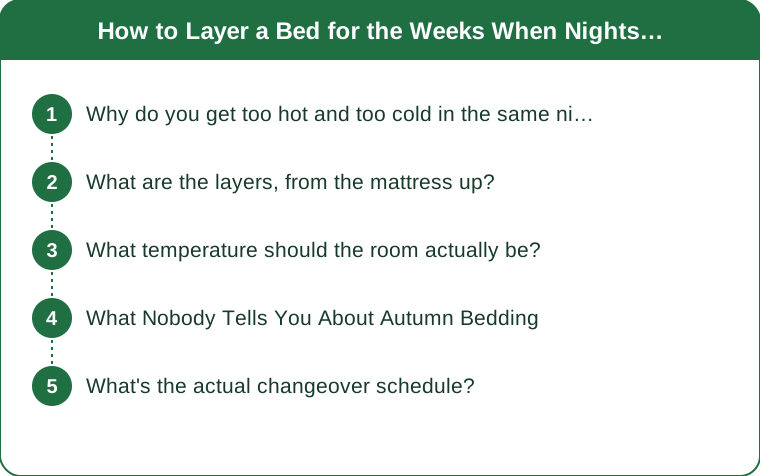
Why do you get too hot and too cold in the same night?
Because two temperature curves are running against each other.
Your core temperature drops overnight — falling from evening onward, reaching its lowest point a couple of hours before you wake. This drop is part of how sleep is initiated and maintained, and it’s why a room that’s too warm makes it hard to fall asleep.
The room’s temperature also drops, but on the outdoor air’s schedule, which in early autumn means a rapid fall after midnight. September nights commonly drop 15 to 20 degrees between bedtime and dawn.
So you get in bed at 11pm when the room is 72°F and your body is still warm. You need very little covering. By 4am the room is 58°F and your core is at its lowest, and you need substantially more.
One duvet cannot serve both states. If it’s right at 11pm you’ll be cold at 4am; if it’s right at 4am you’ll kick it off at midnight and wake up.
The answer isn’t a smarter duvet. It’s a bed you can adjust in three seconds without becoming properly awake.
What are the layers, from the mattress up?
Five, and most people are running three.
1. A mattress protector or pad. Skip anything with a plastic membrane in the transition weeks — they trap heat and moisture, and moisture is the actual reason people feel clammy and then cold. A cotton or wool pad breathes.
2. The fitted sheet. Fiber matters more than thread count. Percale cotton is crisp and cool. Linen is the best transitional fiber there is — it’s breathable when warm and insulating when cool, which is exactly the problem you’re solving. Sateen and jersey sleep warmer, which you want in December and not yet.
3. A flat sheet. A layer people skip and shouldn’t in autumn. It’s the cheapest adjustable layer you have and it’s often the difference between comfortable and not at 11pm.
4. A light quilt or coverlet. A cotton quilt, a light wool blanket, or a summer-weight duvet. This is the main covering for the transition weeks — enough for the middle of the night, not too much at bedtime.
5. A folded blanket across the foot of the bed. The single most useful item in the whole system. At 4am you pull it up with one arm and go back to sleep. Wool is best — high warmth for its weight and it handles moisture well.
That’s the setup. The heavy winter duvet stays in the cupboard until nights are consistently cold, which for most places is several weeks away yet.

What temperature should the room actually be?
Cooler than most people set it, which is the most useful and least popular sleep fact.
The commonly cited range for sleep is roughly 60 to 67°F, with many people landing around 65°F. Warmer than that measurably fragments sleep, particularly in the second half of the night when your body is trying to be at its coolest.
What this means practically in the transition weeks: resist turning the heat on. The instinct at the first cold morning is to switch the heating on for the night, and heating a bedroom to 70°F overnight produces worse sleep than a 60°F room with an extra blanket.
A better sequence:
- Keep the bedroom unheated as long as it’s tolerable, and solve warmth with layers.
- If you use heating, set it to come on shortly before you wake, not overnight. You get a warm room to get up into and a cool room to sleep in.
- Crack a window if outdoor air allows. Fresh cool air is worth a lot, and CO2 buildup in a sealed bedroom is a real and under-discussed sleep factor.
The exception: hands and feet. Cold extremities genuinely delay sleep onset, because your body dumps heat through them to lower your core. Warm feet — socks, a hot water bottle — help you fall asleep in a cool room. Warm room, cold feet is the worst combination and it’s the one most people create.
What Nobody Tells You About Autumn Bedding
Your duvet is probably rated for a colder room than you have. Duvet warmth ratings assume a bedroom around 60°F. A 13.5 tog winter duvet in a heated 70°F bedroom is far too warm, which is why people who set the heating high also complain their duvet is suffocating. Two problems, one cause.
Wool is dramatically better than it sounds. A wool blanket or wool-filled duvet regulates moisture in a way down and synthetics don’t — it absorbs a meaningful amount of moisture vapor without feeling damp. For people who run hot and then get cold, this is the fiber that solves it, and almost nobody considers it.
The clammy feeling isn’t heat — it’s humidity. You lose a substantial amount of water overnight through breathing and sweating. If your layers don’t move that moisture away, you get damp, and damp is what makes you cold at 4am even under enough blankets. This is why fiber choice beats blanket thickness.
Two single duvets on a shared bed solves most couple arguments. Common across Scandinavia, almost unknown elsewhere, and it eliminates the entire problem of two people needing different amounts of covering.
Washing changes warmth. A freshly washed and fully dried down or wool item is loftier and warmer than the same item flat from months of use. If your bedding feels less warm than last year, try a wash and a proper dry before buying more.
What’s the actual changeover schedule?
A practical timeline rather than a single swap day:
Now, through the transition weeks: flat sheet plus a light quilt plus a folded wool blanket at the foot. Room unheated. Socks available.
When nights are consistently below about 50°F: swap the light quilt for a mid-weight duvet, keep the folded blanket. This is usually mid to late October in a temperate climate.
When the heating is on regularly: consider going down a duvet weight, not up. A heated room plus a heavy duvet is the classic overshoot.
Practical jobs worth doing in the next two weeks:
- Air and wash what’s been in storage before you need it. A duvet out of a vacuum bag needs a day to loft and often smells of storage.
- Wash the summer bedding properly before storing it, not after. Body oils that sit in fabric for six months set permanently.
- Check the pillow. Pillows compress and most people keep them years past useful. If it doesn’t spring back when folded, it’s done.
- Buy the wool blanket now if you don’t have one. It’s the item that makes the whole transitional system work and it stays useful all winter as the top layer.
The overall principle: adjustability beats warmth. A bed you can modify at 4am with one arm, half asleep, is a bed you’ll sleep through.
TL;DR:
- You get hot then cold because your core temperature and the room temperature both fall, on different schedules.
- Run five layers: breathable pad, percale or linen sheet, flat sheet, light quilt, and a folded wool blanket at the foot.
- Keep the bedroom around 60–67°F and resist heating it overnight. Warm feet, cool room — never the reverse.
- The clammy-then-cold feeling is moisture, not heat. Fiber choice beats blanket thickness; wool handles it best.
- Don’t swap to the winter duvet yet. Wait until nights are consistently below 50°F, and go lighter if you heat the room.
The goal is a bed you can adjust at 4am with one arm without waking up.
Keep Reading
This article is for general informational and styling purposes only. Fit, sizing, and product availability may vary.