Mattress Rotation: How Often, Which Way, and Why Autumn Is the Easy Reminder
Quick Answer: Most modern mattresses should be rotated head-to-foot every three to six months, and most should not be flipped at all - one-sided construction with a dedicated comfort layer on top is now the norm. Rotation redistributes where your body weight compresses the foam or springs, which slows the development of a permanent dip. Check the manufacturer’s guidance first, because a small number of mattresses are genuinely double-sided. Attaching it to the seasonal bedding changeover is the easiest way to actually remember.
You already know which side of the bed is yours because there is a slight valley there. That valley is doing more to your sleep than the sheets you keep replacing.

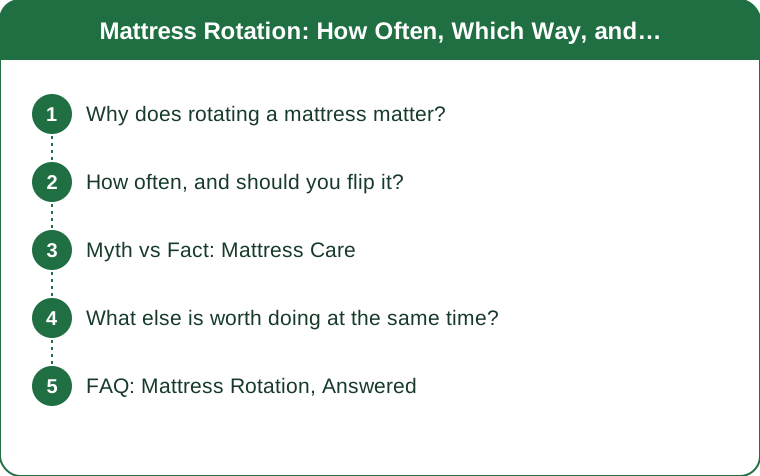
Why does rotating a mattress matter?
Your body compresses the same square metre every night for years. Roughly a third of your life is spent in one position on one section of one surface, concentrated at the shoulders and hips where the most weight sits.
Foam and springs do not recover indefinitely. Comfort layers soften with repeated compression, and once a depression sets in, you sleep deeper into it, which accelerates the process. It is a self-reinforcing loop.
A dip changes your spinal alignment while you sleep. Sinking further at the hips than the shoulders tilts your pelvis, and that is a common contributor to waking with a stiff lower back - frequently blamed on the pillow, the workout, or the age of the person rather than the mattress.
Rotation moves the pressure to a different section of the same surface. Head-to-foot rotation means the area that was under your hips now sits under your calves, and the less-used foot end takes a turn at the heavy work.
Couples benefit most. Two people of different weights sleeping in fixed positions produce two different wear patterns and a ridge between them. Rotation will not eliminate it, but it slows it considerably.
And it can matter for warranty claims. Some manufacturers specify a rotation schedule and treat neglect as misuse when assessing a sagging claim, so the paperwork is worth reading once.
How often, and should you flip it?
Every three to six months is the standard guidance for rotation. Newer mattresses benefit from the more frequent end of that range during the first year, while the comfort layers are settling.
Most modern mattresses should not be flipped. One-sided construction is now the norm - a support core with a purpose-built comfort layer on top only. Flipping it means sleeping on the base, which is uncomfortable and can damage the mattress.
Check the label or the manufacturer’s page before you flip anything. Genuine double-sided mattresses still exist, particularly traditional sprung models, and those do benefit from flipping as well as rotating.
Rotation is head-to-foot, a full 180 degrees. The foot end becomes the head end. It is not a side-to-side move, which does almost nothing on a rectangular mattress.
Toppers need their own rotation. A separate mattress topper compresses the same way and is far easier to rotate - do it whenever you change the bedding if you can be bothered, or at least alongside the mattress.
And rotation does not resurrect a worn-out mattress. If there is a visible permanent depression of a couple of centimetres or more, or you consistently wake sore and sleep better in hotels, rotation is a stopgap rather than a solution.

Myth vs Fact: Mattress Care
Myth: All mattresses should be flipped. Fact: most modern ones should not be - one-sided construction with a dedicated top comfort layer is standard now, and flipping puts you on the support base.
Myth: A firmer mattress prevents dips. Fact: firmness describes how it feels, not how durably it is built. Materials and density drive longevity, and firm mattresses develop wear patterns too.
Myth: A dip means the mattress is defective. Fact: gradual body impressions are normal and expected within limits, and most warranties specify a depth threshold - frequently in the region of two to three centimetres - before a claim is considered.
Myth: A topper fixes a sagging mattress. Fact: a topper follows the contour underneath it. It changes the surface feel and can help with comfort, but it will not level a genuine dip.
Myth: Mattresses need replacing every eight years exactly. Fact: the commonly cited range is roughly seven to ten years, but the honest test is how you sleep and how you feel on waking - not the date on the label. A well-maintained mattress can outlast the number, and a neglected one can fail well before it.
What else is worth doing at the same time?
Vacuum the surface and the base. Mattresses accumulate dust and skin cells, and the underside and the slats collect more than people expect. Five minutes with the upholstery attachment while the mattress is off-square anyway is efficient.
Check the slats and the frame. A cracked or bowed slat produces a dip that looks exactly like mattress failure, and it is a far cheaper fix. Press down along the base with the mattress lifted - anything that gives should be replaced.
Wash the mattress protector properly. It is the item most likely to be washed rarely, and it is the barrier doing the actual protecting. Follow the label, which for most protectors means a warm wash and a low-heat dry.
Air the mattress for a few hours before remaking the bed. Strip it, open the windows, and let it sit uncovered. Moisture accumulates in bedding through the summer, and this is a genuinely useful reset.
Pair it with the seasonal bedding change. The changeover from summer to autumn bedding over the next few weeks is a natural anchor - heavier duvet out, mattress rotated, protector washed, all in one session. Twice a year, spring and autumn, is a schedule people actually keep.
And get help with the lift if you need it. A king-size mattress is heavy and awkward, and rotating one alone is a common way to tweak a back. Slide it rather than lifting it, use the corners, and ask someone to take an end.
FAQ: Mattress Rotation, Answered
How often should you rotate a mattress?
Every three to six months for most mattresses, and toward the more frequent end during the first year while the comfort layers settle. Check your manufacturer’s guidance, since some specify a schedule.
Should I flip my mattress or just rotate it?
Most modern mattresses are one-sided and should only be rotated head-to-foot. Flipping is only appropriate for genuinely double-sided models, which are far less common now - check the label before flipping anything.
Will rotating fix a dip in my mattress?
It slows a dip from developing but will not remove one that has set in. If there is a permanent depression of a couple of centimetres or more and you wake sore, you are past the point rotation solves.
When should I replace my mattress instead?
The commonly cited lifespan is roughly seven to ten years, but the practical test is how you sleep. Persistent morning stiffness, a visible permanent dip, and sleeping noticeably better elsewhere are the signals worth acting on.
TL;DR:
- Rotate head-to-foot every three to six months; most modern mattresses should not be flipped at all.
- Check the label first - genuine double-sided mattresses still exist and do benefit from flipping.
- Rotation slows dips forming but will not fix one that has already set in.
- Do it alongside the seasonal bedding change, and vacuum the mattress, check the slats, and wash the protector while you are there.
- Slide rather than lift, and get a second person for anything king-sized.
The autumn bedding swap is the easiest reminder there is. Four minutes now, and the valley on your side stops getting deeper.
Keep Reading
This article is for general informational and styling purposes only. Fit, sizing, and product availability may vary.