The Best Bedding Materials for Night Sweats (and the Ones That Make It Worse)
Quick Answer: Moisture-wicking materials like TENCEL (lyocell), bamboo-derived fabrics, and high-quality percale cotton perform best for night sweats because they pull moisture away from skin and allow airflow. Synthetic microfiber and high thread-count sateen tend to trap heat and moisture, making sweating worse.
If you’re waking up damp no matter the room temperature, the problem might not be your body — it might be the sheets holding moisture against your skin all night instead of moving it away.
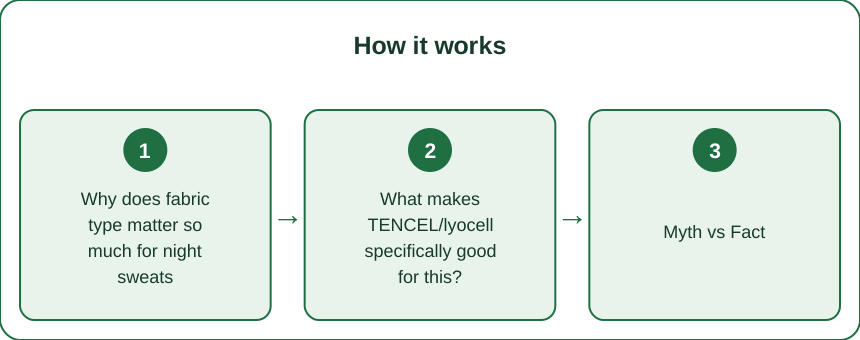
Why does fabric type matter so much for night sweats specifically?
Because different fibers handle moisture completely differently. Natural, breathable fibers (cotton percale, linen, TENCEL/lyocell) have structures that either wick moisture away from skin or allow it to evaporate through the weave. Tightly woven synthetic fabrics (many microfiber blends) trap moisture against the skin because the fiber itself doesn’t absorb or move water efficiently — you stay damp instead of drying.
For someone with genuine night sweats, this difference isn’t cosmetic comfort — it directly affects how quickly you cool down and dry off during the night.
What makes TENCEL/lyocell specifically good for this?
TENCEL is a wood-pulp-derived fiber with naturally high moisture absorption — it can absorb significantly more moisture than cotton before feeling wet to the touch, and it releases that moisture efficiently through evaporation. Combined with a smooth fiber structure that promotes airflow, this makes it one of the top-performing materials specifically for temperature-regulation and moisture management in bedding.
It tends to cost more than basic cotton, but for someone dealing with regular night sweats, it’s often worth the difference for sleep quality alone.
Myth vs Fact: Bedding and Night Sweats
Myth: Higher thread count always means better bedding. Fact: Very high thread counts (600+) are often achieved with finer, more tightly woven fibers that can actually reduce breathability — moderate thread count (200-400) percale often breathes better.
Myth: Silk is cooling for everyone. Fact: Silk feels cool to the touch initially but doesn’t wick moisture as effectively as TENCEL or percale cotton over a full night — it’s a comfort feel, not a moisture-management solution.
Myth: Bamboo bedding is always eco-friendly and better for sweat. Fact: ‘Bamboo’ bedding is often chemically processed into rayon/viscose — check the weave (bamboo lyocell is genuinely good; low-quality bamboo rayon can trap heat similarly to other synthetics).
Does weave matter as much as fiber type?
Almost equally. Percale weave (tight, one-thread-over-one-thread-under, matte finish) breathes significantly better than sateen weave (looser, glossier, more threads floating on the surface) in the same fiber. A cotton sateen sheet can trap more heat than a cotton percale sheet despite being the same fiber, purely because of how the weave affects airflow.
When shopping, look for ‘percale’ specifically if night sweats are a primary concern, even within a fiber type you already trust.
FAQ: Bedding for Night Sweats Questions, Answered
Is cotton or TENCEL better for night sweats?
Both perform well; TENCEL typically edges out cotton in moisture absorption and evaporation rate, but quality percale cotton is a strong, more affordable alternative.
Should I avoid all synthetic bedding?
Not entirely — some performance synthetics designed specifically for moisture-wicking (athletic-style bedding) can work well, but generic polyester or microfiber blends are usually the worst performers for heat and moisture.
Do pillowcases matter as much as sheets for night sweats?
Yes, often overlooked — since your face and neck sweat too, matching your pillowcase material to your sheet strategy matters for overall comfort.
TL;DR:
- TENCEL/lyocell and percale cotton wick moisture and breathe better than synthetic microfiber or sateen
- Very high thread counts don’t automatically mean better breathability
- Weave matters as much as fiber — percale beats sateen for airflow in the same fiber type
- Match pillowcases to the same strategy, not just the top sheet
If you’ve addressed everything else and still wake up damp, check your sheet tag before anything else. This is general information, not medical advice.
Keep Reading
This article is for general informational and styling purposes only. Fit, sizing, and product availability may vary.