Why Your Duvet Ends Up in a Ball at the Bottom of the Cover
Quick Answer: Duvets bunch because the cover is larger than the insert, the corner ties are unused or missing, or the two fabrics are slippery against each other. Fix the size mismatch first - a cover more than 5cm larger in any direction will migrate no matter what you tie. Corner ties plus matched sizing solves it for nearly everyone.
It is a small thing that grinds. You make the bed properly, and within two nights the duvet has migrated into a lump at one end, leaving a flat empty flap of cover where your feet should be.


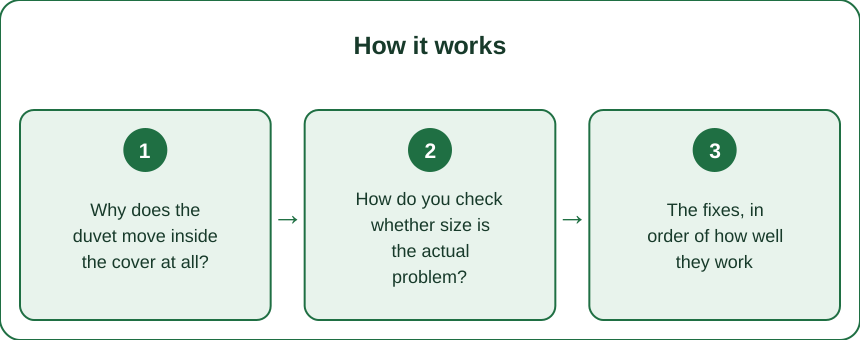
Why does the duvet move inside the cover at all?
Because nothing is holding it still, and everything about a bed encourages migration.
Cause 1: size mismatch. This is the biggest one and the least examined. Duvet sizing is not standardised across countries or even reliably within them. A cover sold as king in one market may be 10 to 15cm larger than a king insert from another. Any spare room inside the cover is room for the insert to slide into, and gravity plus movement fills it over a couple of nights.
Cause 2: no corner ties, or ties nobody uses. Most quality covers have loops or ribbons sewn into the interior corners, designed to be tied to loops on the duvet insert. Two problems: many people do not know they are there, and many cheaper inserts have no corresponding loops to tie to.
Cause 3: fabric pairing. Smooth against smooth slides. A sateen cotton cover over a slippery downproof shell has almost no friction. Percale, linen, and brushed cotton grip considerably better.
Cause 4: how you sleep. A restless sleeper, a shared bed with a duvet tug-of-war, or the habit of pulling the cover up by the top edge all drag the cover relative to the insert.
The order of impact is clear: fix sizing, then ties, then fabric, then habits. People usually try them in reverse and get frustrated.
How do you check whether size is the actual problem?
Measure both. It takes three minutes and it settles the question.
How to measure properly:
- Lay the insert flat on the floor or bed and measure edge to edge in both directions
- Turn the cover inside out, lay it flat, measure the same way
- A difference of 2 to 5cm is normal and fine. The cover needs a little room to be put on at all.
- More than 5cm in either direction is the source of your problem
What to do if the mismatch is large:
- Add ties. If the gap is 5 to 10cm, corner ties will control it. Beyond that, the middle still sags.
- Size up the insert rather than down the cover. A slightly overfilled cover looks fuller and moves less. Covers are cheap to replace; a good insert is not.
- Sew interior ties yourself. Ribbon tape and twenty minutes with a needle. Attach to all four interior corners and, for large covers, at the midpoint of the long sides too.
A note on national sizing, since it explains a lot of otherwise mysterious mismatches: UK, US, European, and Australian duvet sizes differ meaningfully under similar names. If your cover and insert were bought in different countries or from different international retailers, a mismatch is likely rather than possible.
A quick diagnostic: if the duvet always ends up at the same end, it is sizing and gravity. If it twists or balls up in the middle, it is friction and sleeping habits.

The fixes, in order of how well they work
1. Corner ties - the highest-value fix. If both cover and insert have loops, use them. If the insert has none, sew four small ribbon loops onto its corners. This takes fifteen minutes once and solves the problem indefinitely.
- Tie before shaking the cover down, while everything is inside out
- Use a bow, not a knot, so laundry day is not a fight
- Four corners minimum; six points including the long-side midpoints for king sizes
2. Duvet clips or grips. Small plastic or metal clips that pinch cover and insert together from the outside, useful when the insert has no loops and you do not want to sew. They work reasonably well and are visible and occasionally uncomfortable through the fabric.
3. Change the fabric pairing. If you are replacing anything anyway:
- Linen and percale grip well - textured, matte, high friction
- Sateen and silk slide - beautiful, cool, and the worst offenders for migration
- Brushed cotton and flannel grip best of all, which is one reason winter bedding rarely bunches
4. The roll method for putting it on. Turn the cover inside out, lay it on the bed, place the insert on top, tie the corners, roll the whole thing from the top end down like a sausage, then invert the opening over the roll and unroll. It produces a properly seated duvet with far less shaking and far fewer misaligned corners.
5. Shake it out properly each morning. Thirty seconds of holding the top corners and snapping the duvet redistributes the fill and resets the position. Most migration is cumulative, so a daily reset stops it building.
What Nobody Tells You About Duvet Covers
A too-large cover also makes the bed look worse. Beyond the bunching, extra fabric creates flat, hollow edges and the bed reads unmade even when it is not. Hotels use inserts that slightly overfill the cover for exactly this reason - the plumpness is a sizing decision.
The fill affects migration too. A well-baffled down duvet with box construction holds its shape and resists balling. A cheap insert with sewn-through seams or a single chamber lets the fill shift, which makes migration look worse than it is. If the fill is pooling as well as the insert, that is two problems, not one.
Washing shrinks covers, and not evenly. Cotton covers can shrink 3 to 5 percent on a first hot wash, mostly in length. A cover that fitted at purchase can become genuinely too small after several hot washes, which produces the opposite complaint - a struggle to get it on. Wash covers warm rather than hot to keep the fit stable.
Two duvets on one bed is a legitimate solution and standard practice in much of northern Europe. For couples with different temperature preferences or different levels of restlessness, two singles instead of one double eliminates both the tug-of-war and most of the migration. It looks slightly unusual on a made bed and it solves more problems than any clip.
Zips beat buttons for keeping the insert seated. Button closures leave gaps, and those gaps are where a corner works its way out on a restless night. A full-length zip closure is worth the small premium.
Seasonal swaps are the natural time to fix this. As you change from a summer-weight to an autumn-weight insert over the next few weeks, measure both against your covers and sort out the pairing then rather than in December.
FAQ: Duvet Cover Questions, Answered
Do duvet clips damage the fabric?
Good quality clips with smooth edges do not, though repeated clipping in the same spot can leave a mark on fine fabric. Interior ties are gentler and invisible.
Should the insert be bigger or smaller than the cover?
The insert should be very slightly smaller - about 2 to 5cm - so it fits without straining seams while still filling the cover. Any more room than that and it migrates.
Which fabric bunches the least?
Linen and brushed cotton, because their texture creates friction. Sateen is the most slippery of the common cotton weaves, and silk more so.
Why does it happen more in summer?
Lighter summer inserts are less heavy and less lofty, so there is more empty space in the cover and less weight holding it in place. It is also the time of year people move more in their sleep.
Is there a trick for putting a cover on alone?
The roll method described above is the most reliable - inside out, insert on top, tie corners, roll from the top, then invert and unroll. It is far easier than the traditional shake and considerably less likely to end with a corner unfilled.
TL;DR:
- Measure both cover and insert - more than 5cm difference is the root cause for most people
- Corner ties are the highest-value fix; sew loops onto the insert if it has none
- Linen, percale, and brushed cotton grip; sateen and silk slide
- Use the roll method to put the cover on, and shake the duvet out daily to reset it
- Two single duvets on a shared bed solves migration and temperature disagreements at once
This is a fifteen-minute problem masquerading as a permanent annoyance. Measure, tie the corners, and pick a cover fabric with some texture to it - and the duvet stays where you put it.
Keep Reading
This article is for general informational and styling purposes only. Fit, sizing, and product availability may vary.