The Shoulder-Season Bedding Problem: Hot at Midnight, Freezing at 5am
Quick Answer: Late-summer and early-autumn nights drop far more between bedtime and dawn than summer or winter nights do, and a single duvet can only be right for one of those temperatures. The fix is layering rather than switching: a lighter-tog duvet plus a folded blanket at the foot of the bed, so you can add warmth at 4am without fully waking up. Natural fibres handle the swing better than synthetics because they manage moisture as well as heat.
You kick the duvet off at midnight and wake up cold at five, and then you do it again the next night for six weeks straight.
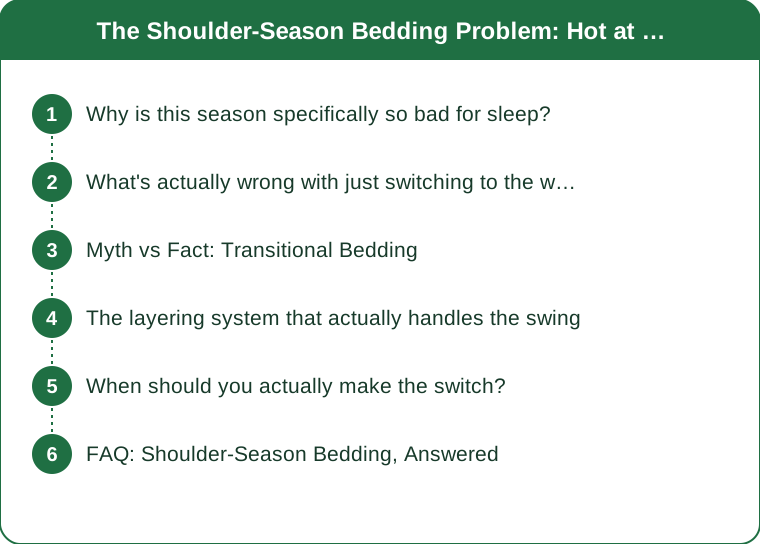
Why is this season specifically so bad for sleep?
Because the overnight temperature swing is at its annual maximum, and your bedding isn’t.
Clear autumn nights lose heat fast. Lower humidity and fewer clouds mean the ground and the air radiate heat to the sky efficiently overnight - which is exactly why frost warnings appear in autumn on days that hit 70 degrees in the afternoon. Swings of 20-25 degrees between afternoon high and pre-dawn low are routine in September and October, versus much smaller swings in humid midsummer.
Your bedroom follows that curve with a lag. It’s still holding the day’s heat at bedtime and it’s at its coldest around 4-6am - which coincides almost exactly with the part of the night when your body is least able to compensate.
Your own temperature is also moving. Core body temperature follows a daily rhythm, dropping through the night and reaching its lowest point in the pre-dawn hours - typically an hour or two before you wake. So the room is coldest at exactly the moment you’re least internally warm. That’s why 5am specifically, and not 2am.
A single duvet cannot solve a moving problem. Whatever tog you choose is either right for 11pm or right for 5am, and you spend the rest of the night on the wrong side of it.
What’s actually wrong with just switching to the winter duvet?
It fixes the second half of the night and ruins the first.
A higher-tog duvet at 11pm in a room still holding daytime heat makes you overheat before you fall asleep - and your body needs to shed heat in order to initiate sleep at all. A core temperature drop of a degree or so is part of the normal sleep-onset process, and a too-warm bed physically obstructs it. That’s why an overly warm bed produces trouble falling asleep, not just discomfort.
Then you overheat, sweat, kick it off, and now you’re damp under a cold duvet at 4am, which is meaningfully worse than simply being cold.
The moisture piece is what most people miss. A synthetic duvet or polyester sheets hold that moisture against your skin rather than moving it away, and evaporative cooling on damp skin in a cold room is a genuinely unpleasant way to wake up.
Which leaves three options, in order of how well they work:
- Layering - a lighter base plus an addable layer. Adjustable without a full wake-up.
- Split-tog or all-season duvets - two duvets that clip together. Good, but you’re still committed for the whole night.
- Switching duvets seasonally - fine in deep summer and deep winter, wrong for the six weeks in between.
Myth vs Fact: Transitional Bedding
Myth: Higher thread count means a cooler, better sheet. Fact: Thread count above roughly 400 mostly reflects manufacturing technique rather than quality, and very high counts often mean a denser, less breathable fabric. Weave and fibre matter far more than the number - percale is cooler than sateen, and linen is cooler than either.
Myth: You should change your whole bedding set at the same time each autumn. Fact: The date isn’t the variable - your bedroom’s overnight low is. Someone in a well-insulated flat and someone in a draughty old house should switch weeks apart.
Myth: Wool bedding is for winter only. Fact: Wool is one of the best transitional materials specifically because it buffers both temperature and moisture. It absorbs a substantial fraction of its weight in moisture vapour without feeling damp, which is exactly the shoulder-season problem.
Myth: Fleece sheets are cosy and therefore good for cold nights. Fact: Fleece traps heat effectively and handles moisture poorly. If you’re the person who overheats at midnight and freezes at five, fleece makes the first half worse without helping the second.
Myth: If you’re cold at 5am you need a warmer duvet. Fact: Frequently you need a warmer foot of the bed and better moisture management. Cold feet drive a disproportionate share of the sensation of being cold, and a folded blanket over the lower third is a smaller intervention than a whole new duvet.
The layering system that actually handles the swing
Four layers, built from the mattress up. Most people already own three of them.
Layer 1 - The sheet: percale cotton or linen. Percale is a plain crisp weave that breathes better than sateen. Linen is better still, gets softer with washing, and handles moisture exceptionally. This is the layer touching your skin all night, so fibre choice matters more here than anywhere else - and it’s where switching away from polyester blends pays off most.
Layer 2 - The main duvet: mid-weight, roughly 7-10.5 tog. Lighter than your winter duvet, heavier than high summer. This is the layer that’s right at bedtime and slightly insufficient at dawn - which is the correct compromise, because insufficient is fixable and excessive isn’t.
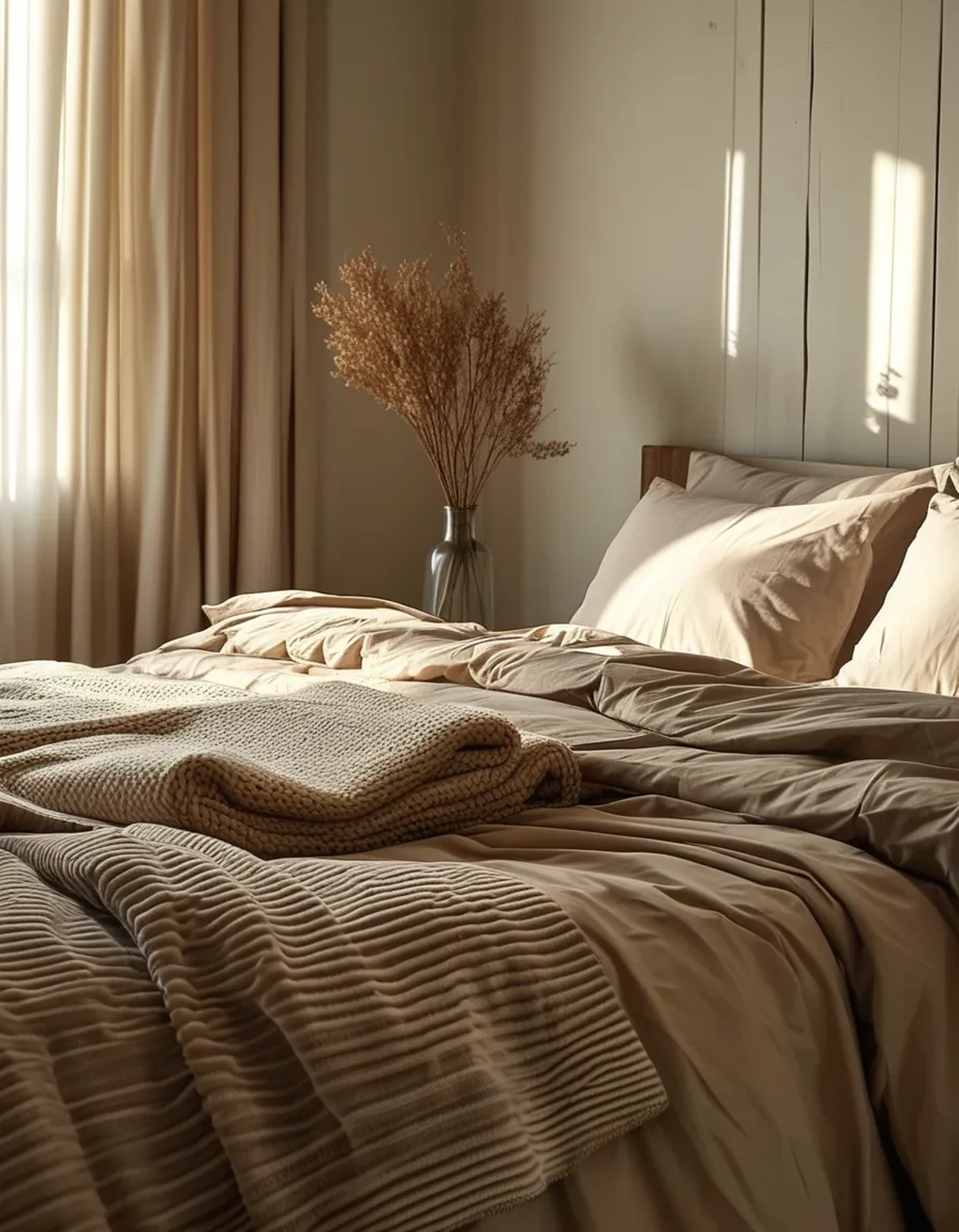
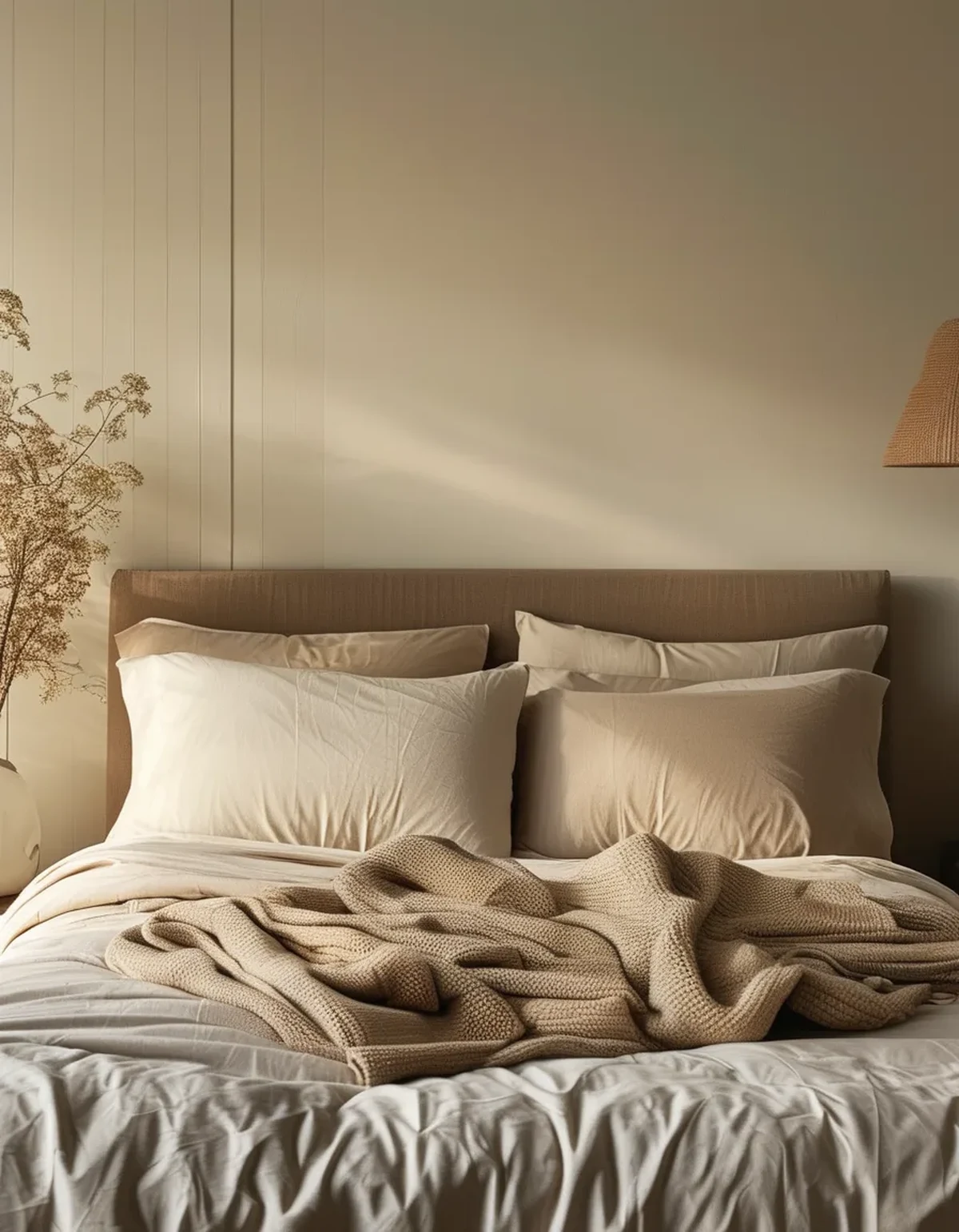
Layer 3 - The addable blanket, folded across the foot of the bed. Wool or cotton waffle weave, folded to cover the bottom third. This is the whole system in one item. At 4am you pull it up without getting out of bed or fully waking. It also keeps your feet warm all night while your torso stays cool, which suits how people actually lose heat.
Layer 4 - The pillowcase, changed independently. Your head is where a lot of heat leaves. Swapping a sateen pillowcase for percale or linen is a small change with a disproportionate effect on how hot the bed feels.
Practical notes: keep the winter duvet accessible but not on the bed. Two smaller duvets for a shared bed genuinely solves the problem of two people with different thermostats. And a bedroom at 60-67°F is the commonly cited range for sleep - if yours is well above that at bedtime, opening a window an hour before bed does more than any bedding change.
When should you actually make the switch?
Watch the overnight low, not the calendar.
Overnight lows above 65°F: stay in summer setup. Light duvet or just a sheet and a light blanket, percale or linen throughout.
Overnight lows 55-65°F - this is the shoulder season: the layered system above. This is typically September through mid-October in the northern US, and it’s the period that causes all the trouble.
Overnight lows 45-55°F: move to the mid-weight duvet as your main layer with the blanket still available. Add a mattress topper if your bed sits near an outside wall.
Overnight lows below 45°F: winter duvet, and the folded blanket becomes optional rather than essential.
Two things worth doing at the switch point, since you’re changing the bed anyway:
Air and refresh the stored bedding before it goes on. Duvets and blankets that spent the summer compressed in a bag need a few hours to loft properly, and lofting is where the insulation actually comes from. A compressed duvet performs well below its tog rating.
Check the pillows. Pillows degrade continuously and invisibly, and a flattened pillow contributes to neck complaints that get blamed on mattresses. The fold test: fold it in half; if it stays folded rather than springing back, it’s finished.
And if you share a bed with someone whose thermostat disagrees with yours, this is the season it becomes unmanageable. Two single duvets on a double bed looks unconventional in the UK and Europe and is entirely standard in Scandinavia - and it is, by a wide margin, the most effective solution to that particular problem.
FAQ: Shoulder-Season Bedding, Answered
What tog duvet should I use in early autumn?
Roughly 7-10.5 tog suits most people for transitional nights, with a blanket available. Your bedroom’s insulation and your own thermostat shift that more than the season does.
Is linen worth the price for transitional weather?
If you run hot or sweat at night, it’s the single most effective bedding change available - it moves moisture well and works across a wider temperature range than cotton. It’s expensive and it lasts years, so the cost per night is lower than the price tag suggests.
Why do I wake up at 4am specifically?
Your core body temperature reaches its daily low in the pre-dawn hours, at the same time the room reaches its coldest. The two lows coincide, which is why that hour and not another.
Do weighted blankets help or hurt in transitional weather?
It depends entirely on the fill and cover. Glass-bead fills with a breathable cotton cover are manageable; poly-pellet fills with a plush cover retain a lot of heat and will make the midnight half of the night worse.
TL;DR:
- Autumn nights swing 20-25 degrees, and one duvet can only be right for one temperature
- Layer instead of switching: mid-tog duvet plus a folded blanket across the foot of the bed
- Percale or linen beats sateen and polyester because moisture matters as much as heat
- You wake at 4-5am because your core temperature low and the room’s low coincide
- Switch by overnight low, not by date - 55-65°F is the shoulder-season range
One blanket, folded across the bottom third, solves most of a six-week sleep problem.
Keep Reading
This article is for general informational and styling purposes only. Fit, sizing, and product availability may vary.