Weighted Blankets, Honestly: What the Science Says and Who They Actually Help
Weighted blankets went from occupational-therapy tool to wellness-aisle sensation fast — which usually means the marketing has outrun the evidence. The honest guide: how the calming weight is supposed to work, what the science actually supports, and who these blankets genuinely help versus who’s buying a heavy placebo.

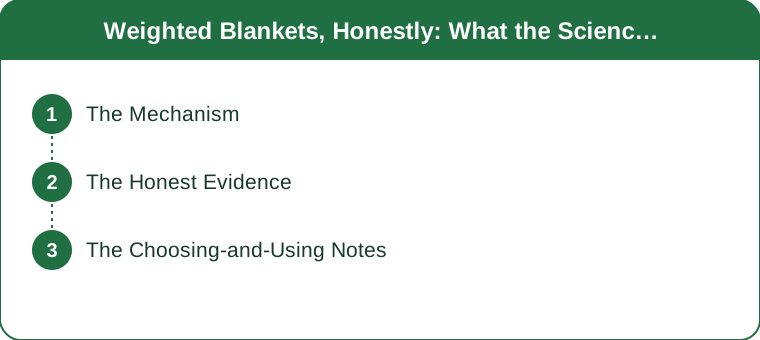
The Mechanism
How the weight is meant to work: the deep-pressure-stimulation theory (the gentle, even weight providing ‘deep pressure’ that may calm the nervous system — the swaddle-for-adults idea; the pressure-soothes hypothesis), the calming-response claim (the pressure potentially nudging the rest-and-calm nervous system — the relaxation mechanism; the anxiety-and-sleep target), the origin-story context (the weighted blankets’ roots in occupational therapy for sensory needs — the legitimate-tool history; the mainstream-crossover), the feels-nice-reality (the many-people-find-it-comforting truth regardless of mechanism — the subjective-comfort that’s real even if modest), and the honest-framing note (the weighted blanket as a possible sleep-and-calm aid, not a cure — the realistic-expectations from the better-sleep chapter; the one-tool-among-many).

The Honest Evidence
What the science actually shows: the modest-and-mixed reality (the research showing some benefit for anxiety and subjective sleep in some studies — the promising-but-not-conclusive picture; the don’t-overstate honesty), the anxiety-signal (the better-evidence-for-anxiety-and-calm than for hard-sleep-metrics — the where-it-seems-to-help-most; the subjective-comfort strength), the individual-response truth (the works-great-for-some, nothing-for-others reality — the try-and-see; the no-guarantee), the placebo-and-comfort honesty (the some-of-the-benefit-may-be-comfort-and-expectation — the and-that’s-okay-if-it-helps framing; the harmless-if-it-works-for-you), the not-a-treatment boundary (the weighted blanket as a comfort-aid, not a replacement for anxiety-or-sleep-disorder treatment — the see-a-professional-for-real-problems; the adjunct-not-cure), and the realistic-expectations frame (the modest-comfort-aid honesty over the miracle-marketing; the buy-informed).
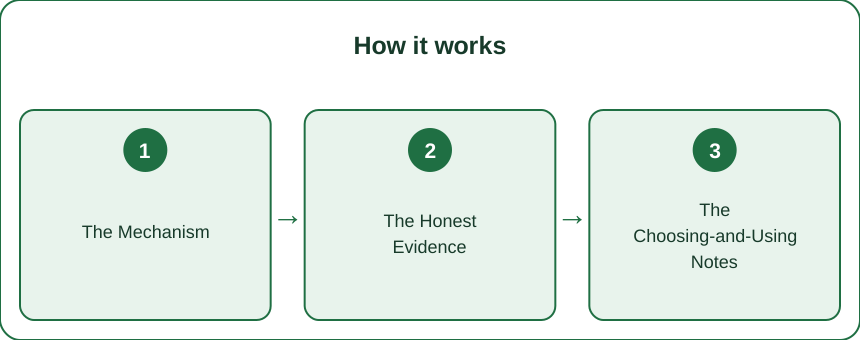
The Choosing-and-Using Notes
If you want to try one: the weight-guideline (the roughly-ten-percent-of-body-weight rule of thumb — the not-too-heavy; the comfortable-not-crushing), the safety-cautions (the not-for-young-children, the respiratory-and-mobility considerations — the who-should-avoid; the check-first for certain conditions), the fabric-and-season note (the breathable-versus-hot reality — the cooling-weighted options for hot sleepers from the summer-bedding chapter; the temperature-management), the return-policy-and-try approach (the buy-with-a-return-window given the individual-response — the test-it-out; the no-guarantee purchase), the how-to-use tips (the on-the-couch-or-bed, the whole-body-or-lap use — the find-what’s-comfortable), the manage-expectations reminder (the modest-comfort-aid, not-a-cure — the try-it-hopeful-not-desperate), and the frame (weighted blankets as a modest, genuinely-comforting-for-some, harmless sleep-and-calm aid — the honest evidence over the wellness-hype; the heavy-hug that helps some and does little for others). Ten-percent weight, breathable fabric, try-with-a-return: the blanket, honestly considered.
Weighted blankets provide ‘deep pressure’ that may calm the nervous system — the evidence is modest and mixed, strongest for anxiety and subjective comfort, and highly individual. They’re a harmless comfort-aid, not a cure. If curious, pick roughly 10% of body weight, breathable fabric, and buy with a return window.
Keep Reading
This article is for general informational and styling purposes only. Fit, sizing, and product availability may vary.