When to Switch Your Bedding for Autumn (It's Later Than You Think)
Quick Answer: Switch bedding based on overnight low temperature, not the calendar. The useful trigger is when overnight lows sit below about 15C for a week straight - which in most temperate regions is late September or October, not early September. Before that, add a folded throw at the foot of the bed rather than changing the whole setup.
There is a strong instinct to swap the bedding the moment the shops fill with autumn colours. Doing it in early September usually means three weeks of kicking the duvet off at 3am, which costs you more sleep than the cosy aesthetic is worth.

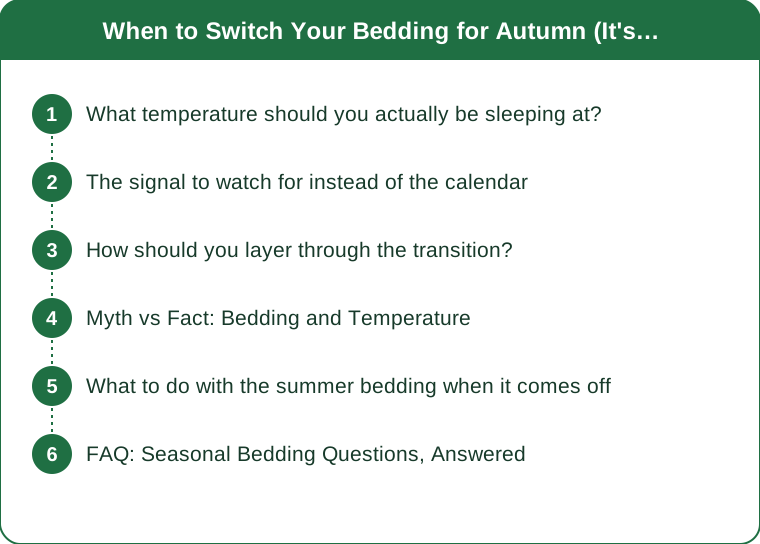
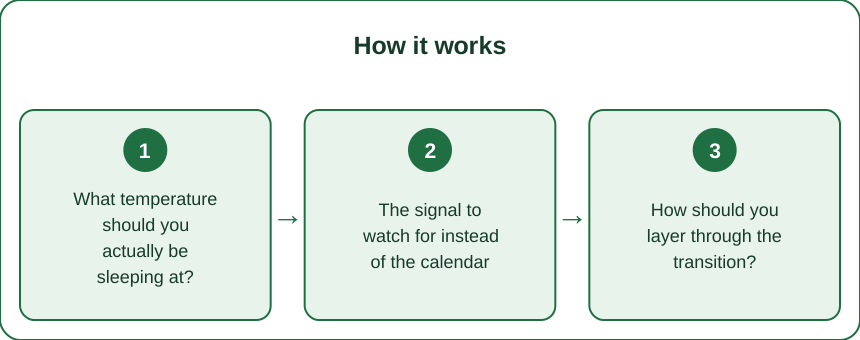
What temperature should you actually be sleeping at?
Sleep researchers generally converge on a bedroom in the mid-to-high teens Celsius - roughly 15-19C - as optimal for most adults, with individual variation on either side.
The reason is physiological. Core body temperature needs to drop by around 1C for sleep to initiate and consolidate properly. A room that is too warm interferes with that drop, which is why hot nights produce fragmented sleep and vivid, memorable dreams from frequent brief wakings.
Your bedding is one half of the equation and the room is the other. A tog rating that works beautifully in a 16C bedroom is oppressive in a 21C one. Anyone giving you a single tog recommendation without knowing your room temperature is guessing.
How to actually find your number: put a cheap thermometer on the bedside table for a week and note the reading when you wake. Most people are surprised - bedrooms with the door closed and a person in them run several degrees warmer overnight than the daytime reading suggests.
The most common error: people upgrade to a heavier duvet in September, get hot, and then open the window - which is a more expensive way of reaching the same temperature they had before.
The signal to watch for instead of the calendar
Overnight low below 15C for seven consecutive nights. That is the practical trigger, and it is checkable on any weather app in about ten seconds.
Why a week rather than one cold night: late summer produces isolated cool nights between warm spells. Changing the whole bed for one of them means changing it back three days later.
Why the overnight low rather than the daytime high: the daytime figure is irrelevant to what happens at 3am. A 26C afternoon can precede a 12C night, and it is the 12C that determines what you need on the bed.
In most temperate regions this lands somewhere between late September and mid-October - which is typically two to four weeks after people actually make the change.
The intermediate move: a folded wool or cotton throw across the bottom third of the bed. It costs nothing, it is there if the night turns cold, and it can be kicked off without waking properly. This handles the entire transitional period, which is longer than the switch itself.
One exception worth noting: if you sleep with a window open year-round, your effective room temperature tracks the outside far more closely and you will need to change over earlier than someone who sleeps with the window shut.
How should you layer through the transition?
Layering beats swapping, for the same reason it works in clothing - it lets you adjust without a full change.
The transitional stack, bottom to top:
- Cotton or linen fitted sheet. Both breathe well; linen wicks moisture better and gets softer with washing. Percale cotton sleeps cooler than sateen, which has a smoother, warmer hand.
- A flat sheet - the layer most people skip and the most useful one in transitional weather. It is a thin, adjustable temperature layer and it keeps the duvet cover clean between washes.
- Your summer duvet, still. Do not rush this one.
- A folded throw at the foot. Wool, cotton waffle, or a light quilt. This is the piece that does the actual transitional work.
Why this beats a mid-weight duvet: a single mid-weight duvet gives you one temperature. This gives you four, and you can change between them half-asleep without getting out of bed.
When the duvet finally changes: go up one step, not two. Jumping from a summer weight straight to a deep-winter one in October is how people end up sleeping badly for a month and blaming stress.

Myth vs Fact: Bedding and Temperature
Myth: Higher thread count means better, cooler sheets. Fact: Above roughly 400, higher thread counts often mean finer, more tightly packed threads and less airflow. Weave type matters more than the number - percale sleeps cooler than sateen at the same count.
Myth: Natural fibres are always cooler than synthetics. Fact: Natural fibres generally breathe and manage moisture better, which is why they feel cooler. But a well-made technical fabric can outperform a poor-quality cotton. Fibre quality matters as much as fibre type.
Myth: You should wash bedding less to preserve it. Fact: Weekly washing of sheets is the general recommendation, and more often in hot weather when you are sweating into them. Accumulated body oils degrade fabric too.
Myth: A heavier duvet helps you sleep more deeply. Fact: Weight and warmth are different things, and they get conflated. Weighted blankets are a separate category with their own considerations - a warm duvet that overheats you fragments sleep regardless of how heavy it is.
Myth: If you’re cold at night, you need more bedding. Fact: Cold feet specifically are often a circulation issue rather than a bedding one, and socks solve it more effectively than a heavier duvet. Being cold all over is a bedding problem; cold extremities usually is not.
What to do with the summer bedding when it comes off
How you store it determines whether it is usable next June.
Wash and dry completely before storing. Body oils and any residual moisture are what cause yellowing and musty smells over a stored season. Completely dry means genuinely dry, not almost.
Skip the vacuum bags for anything natural. Compressing down, feathers, or wool for months damages the loft and it does not fully recover. A breathable cotton storage bag or an old pillowcase is better. Vacuum bags are fine for synthetics.
Store somewhere dry and dark. Under-bed storage is convenient and usually fine; lofts and garages swing in temperature and humidity in ways that are not.
Do not use scented products for storage. Fragrance sheets and scented sachets can transfer smells that survive a wash and are unpleasant to discover in June.
Late summer is the right time to assess replacements. Look at your summer duvet before it goes away: clumped filling that does not redistribute when shaken, thin patches you can see light through, or a persistent smell after washing all mean it should not be stored for next year.
Buy off-season if you are replacing. Summer bedding is at its cheapest in September and October, which is exactly when you have just established that you need new ones.
FAQ: Seasonal Bedding Questions, Answered
What tog duvet do I actually need for autumn?
It depends entirely on your bedroom temperature. As a rough guide, a mid-weight duvet suits a bedroom in the mid-teens; a warmer room needs less than the packaging suggests. Measure your room before buying.
Can I just use two summer duvets instead of buying a winter one?
Yes, and it is genuinely more adaptable. Two lighter duvets that can be used separately, together, or one each if you share a bed with someone whose temperature preference differs from yours solves several problems at once.
How often should I wash bedding in transitional weather?
Weekly for sheets remains the standard. In warm late-summer weather where you are sweating overnight, more frequently is better.
Is it worth having separate duvets if you share a bed?
If one of you is consistently too hot and the other too cold, separate duvets solve it completely and are standard practice in much of Europe. It is the single most effective fix for mismatched sleep temperatures.
TL;DR:
- Switch on overnight lows below 15C for seven straight nights, not on a calendar date
- That trigger usually lands late September to mid-October - later than most people change over
- A folded throw at the foot of the bed handles the whole transitional period
- Percale sleeps cooler than sateen; weave matters more than thread count
- Wash and fully dry summer bedding before storing, and skip vacuum bags for natural fills
Summer bedding is cheapest in September, which is exactly when you find out you need to replace it.
Keep Reading
This article is for general informational and styling purposes only. Fit, sizing, and product availability may vary.